

What are you looking for?
You might be looking for...

ASMR Performance. A slow reading of 8 poems and a closing phrase
Borja Zabala
Activity open to all and free of charge, limited to 55 people
Language: Spanish
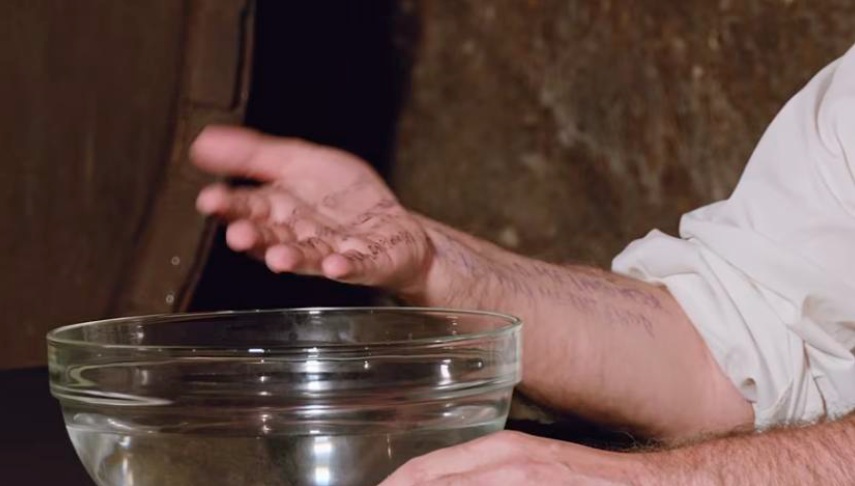
Borja Zabala. Afternoon of two-stage actions: Em rento les mans. Performance. © ARBAR 2025
Borja Zabala explores the relationship between poetry and space, the same field of action in which thought, voice and place are shaped and confused. His action stems from this reflection and takes concrete form in deeds: saying the poems slowly out loud and repeating wandering gestures. This gives rise to a sober, lucid and combative language, marked by an awareness of its limits: freedom and containment, voice and silence, stillness and movement. These actions do not seek to represent the world, but to activate it: to generate presence and open cracks in established discourses.
Activity curated by Marta Pol Rigau
With the participation of Borja Zabala
Borja Zabala (BZ) is a key figure from the action art movement in Spain in the 1990s. He understands performance as a space for debate and moves from expressive ritual to an austere and anti-theatrical post-conceptual discourse, with critical humour against the institution and the market. He removed himself from the public sphere in 1996, re-emerging in 2000 to carry out his activity on social media; he currently works in hybrid formats from a poetic dimension. He participates in Viva Veu and Club 7 and performs at La Virreina, the Museo Nacional Centro de Arte Reina Sofía, MACBA, the Museu Tàpies, ARBAR and the Santa Mònica.
Marta Pol i Rigau holds an undergraduate degree and a PhD in Art History (UAB), with a specialisation in Post-War and Contemporary Art (Sotheby's Educational Studies, London). She holds a master's degree in Cultural Management and a postgraduate degree in Cultural Management and Policy (UB), receiving a scholarship from the University College Dublin. Her research focuses on the theoretical and curatorial framework of action art. She has published in specialised magazines and books and has curated numerous exhibitions and festivals. She currently directs the ARBAR art centre, dedicated to researching performative processes in disused rural environments.
Thursdays of voice and word 2026 builds on the proposals of creators regularly invited by:
Thursdays of voice and word

Thursdays of voice and word
Thursdays of voice and word

Thursdays of voice and word
Thursdays of voice and word