What are you looking for?
You might be looking for...

Flagged for Explicit Image
!Mediengruppe Bitnik
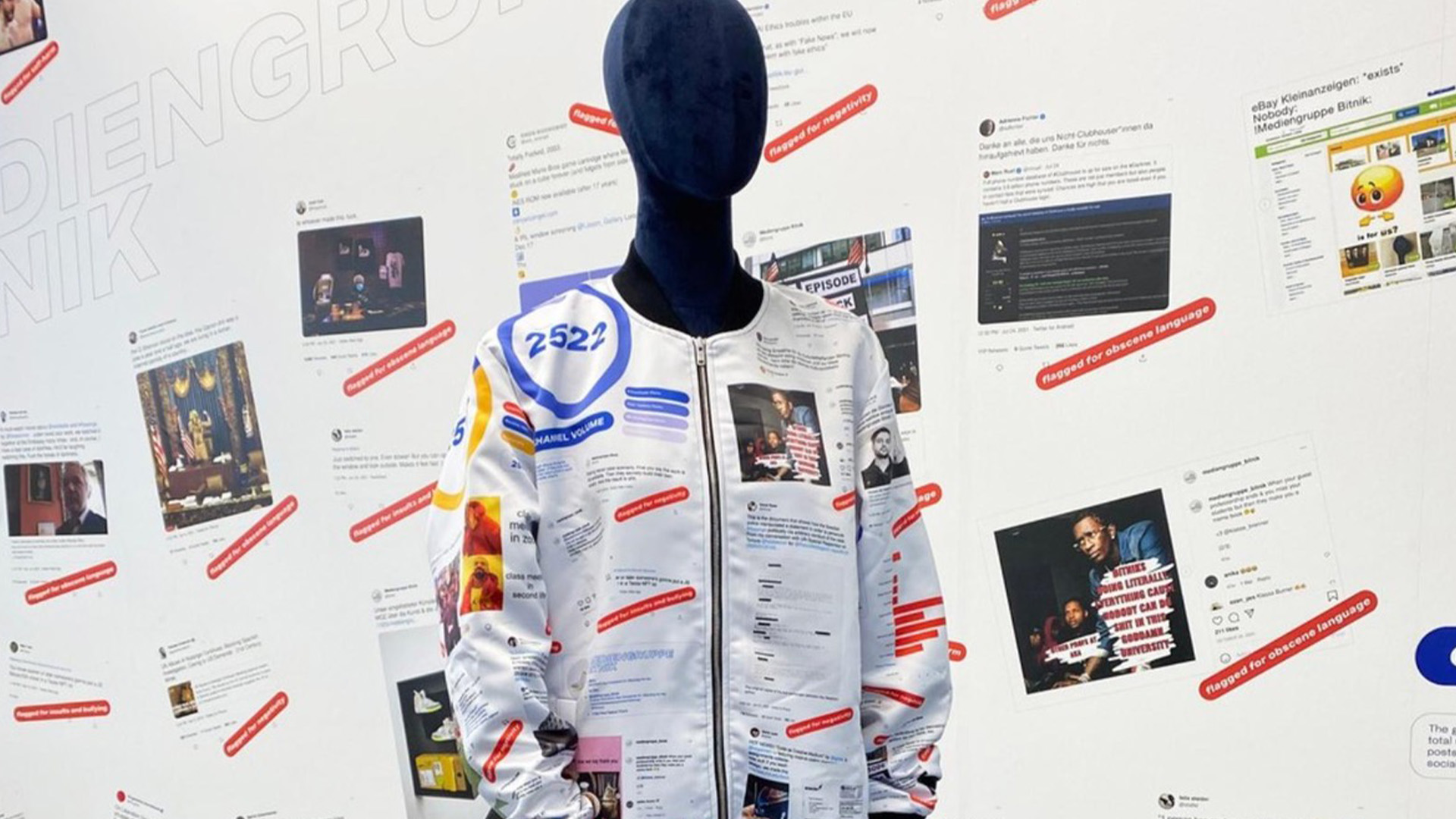
What do algorithms see when they look at your social media profile? Are you a good provider of content? And what exactly is good? What does the algorithmic view of your social media profiles say about you?
Analyses of social media profiles are used in an increasing number of real-world transactions. From border control to job applications, social media profiles are used to assess the threat-levels of a candidate and verify their suitability to enter a country or organisation.
Many of these social media background checks are done automatically by algorithmic entities. How and what do these algorithms assess exactly? And what do their assessments look like?
In Flagged for Explicit Image, !Mediengruppe Bitnik evaluate their own social media data through a commercial screening algorithm for job applicants and print it on a jacket and wallpaper for all to see. Like the clothes we wear, our social media profiles have become the carriers of our identities.
Social Media Rating: Bad! is the rating Bitnik finally receive after running their social media accounts through a commercial social media background checker commonly employed for evaluating job applicants. Bitnik render their score in neon writing. Do not hire them!
Flagged for Explicit Image and Social Media Rating: Bad! are part of a series of works investigating how social media data is used in assessing candidates risks for real-world applications like travel, employment and insurance.
Credits
Image 1:
Exhibition view: Liste Art Fair, Basel (CH), 2021
Photo: Studio Shapiro. Courtesy of the artists and Super Dakota, Brussels
Image 2:
Exhibition view: LINZ FMR, Linz (AT), 2023
Photos: Violetta Wakolbinger
!Mediengruppe Bitnik
!Mediengruppe Bitnik are contemporary artists working on, and with, the Internet. Their practice expands from the digital to physical spaces, often intentionally applying loss of control to challenge established structures and mechanisms.
In the past they have been known to subvert surveillance cameras, bug an opera house to broadcast its performances outside, send a parcel containing a camera to Julian Assange at the Ecuadorian Embassy in London and physically glitch a building. In 2014, they sent a bot called “Random Darknet Shopper” on a three-month shopping spree in the darknets, where it randomly bought items like keys, cigarettes, trainers and ecstasy and had them sent directly to the gallery space.
!Mediengruppe Bitnik’s works formulate fundamental questions about contemporary issues.