What are you looking for?
You might be looking for...

Les nuits d’attente
May Murad
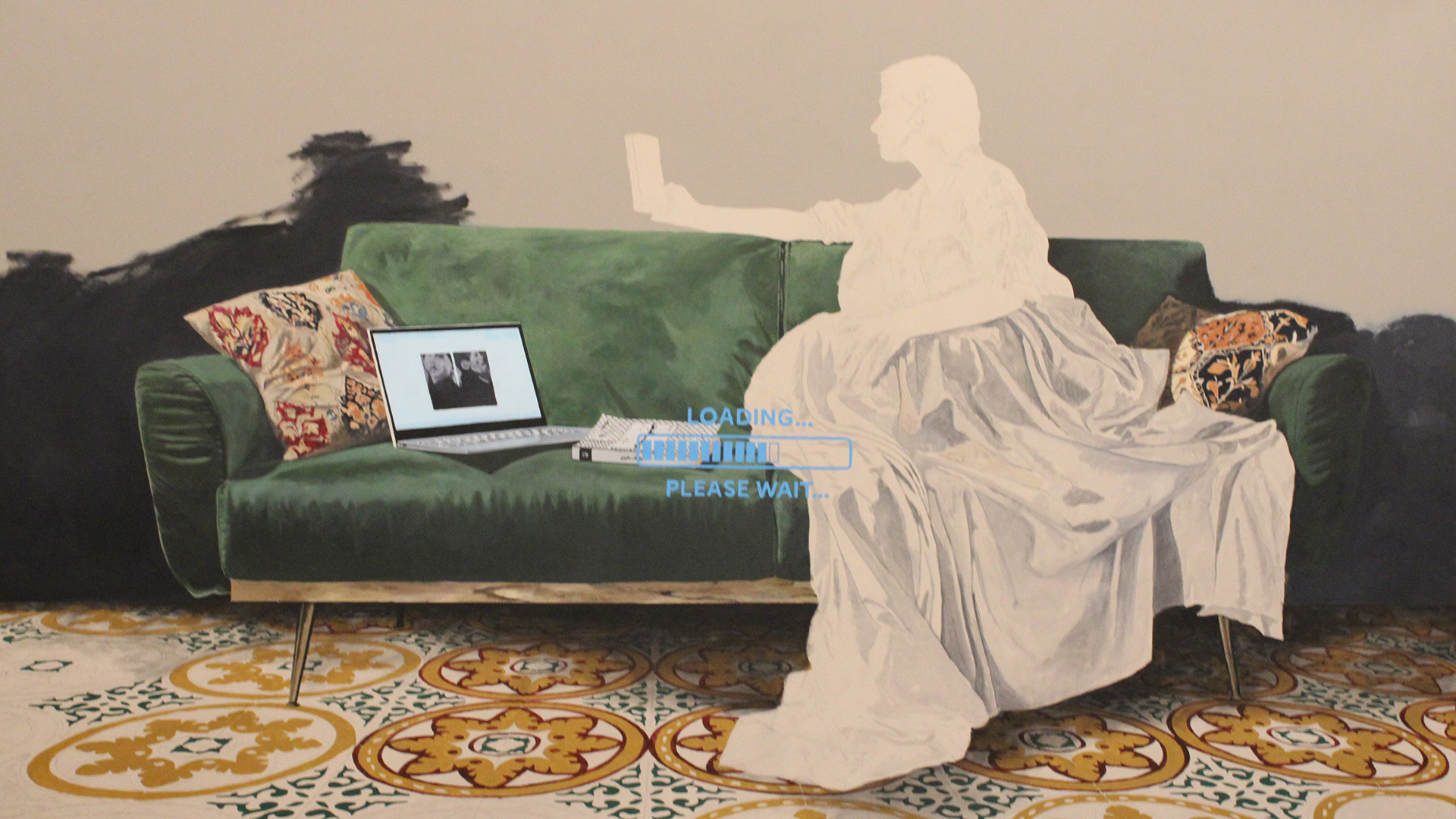
This new triptych is part of May Murad’s ongoing project Erreur humaine. It explores the relationship between the human body, the digital image, and the virtual spaces that increasingly shape the way people exist and connect today. In these paintings, the screen, the phone, and signs of connection appear as traces of a fragile presence. They evoke Murad’s lived experiences in Gaza, the nights spent waiting for news from her family, and the feelings of distance, solitude and fragmentation created by the impossibility of real contact.
The first painting presents an image that is still incomplete, as if a body is slowly coming into existence. It carries the idea of “loading”, of waiting, as if existence itself has become dependent on a digital system. In the second painting, the image fragments and explodes. The body becomes almost a digital trace, crossed by layers, glitches and artificial movements, suspended between presence and disappearance.
In the third painting, the body returns. The image regains a sense of calm and humanity, yet the relationship with the screen remains present: a fragile attempt to maintain a connection across distance.
Through this triptych, May Murad reflects on a contemporary condition in which people are constantly connected but sometimes emotionally absent. Painting becomes a space of resistance against the speed of the digital world, a place where the image regains a slower, human, and sensitive rhythm.
May Murad
May Murad, born in 1984 in Gaza, is a Palestinian visual artist living and working in Paris. She graduated from the Faculty of Fine Arts at Al-Aqsa University in 2006, and her artistic practice focuses on sketching and painting, drawing from her experience in Gaza and by the social, economic and political realities surrounding it.
Her work explores questions of identity, confinement, memory, absence and displacement, as well as the power relations that shape individual and collective experiences. She is also interested in the ways digital technologies transform our relationship with images, memory and one another. Screens, interfaces and digital symbols become familiar elements in her work, while carrying emotional and political meanings.
She holds a master’s degree in Geopolitics of Art and Culture from Sorbonne Nouvelle, where she studied contemporary Palestinian art in times of crisis. She is currently carrying out her doctoral research at Sorbonne Nouvelle.
Murad has exhibited her work in Palestine and internationally, including at the Cité internationale des arts and Galerie Danysz in Paris; Palais de Tokyo; MO.CO. Montpellier, and the Institut du monde arabe.