What are you looking for?
You might be looking for...

Strike
Hito Steyerl
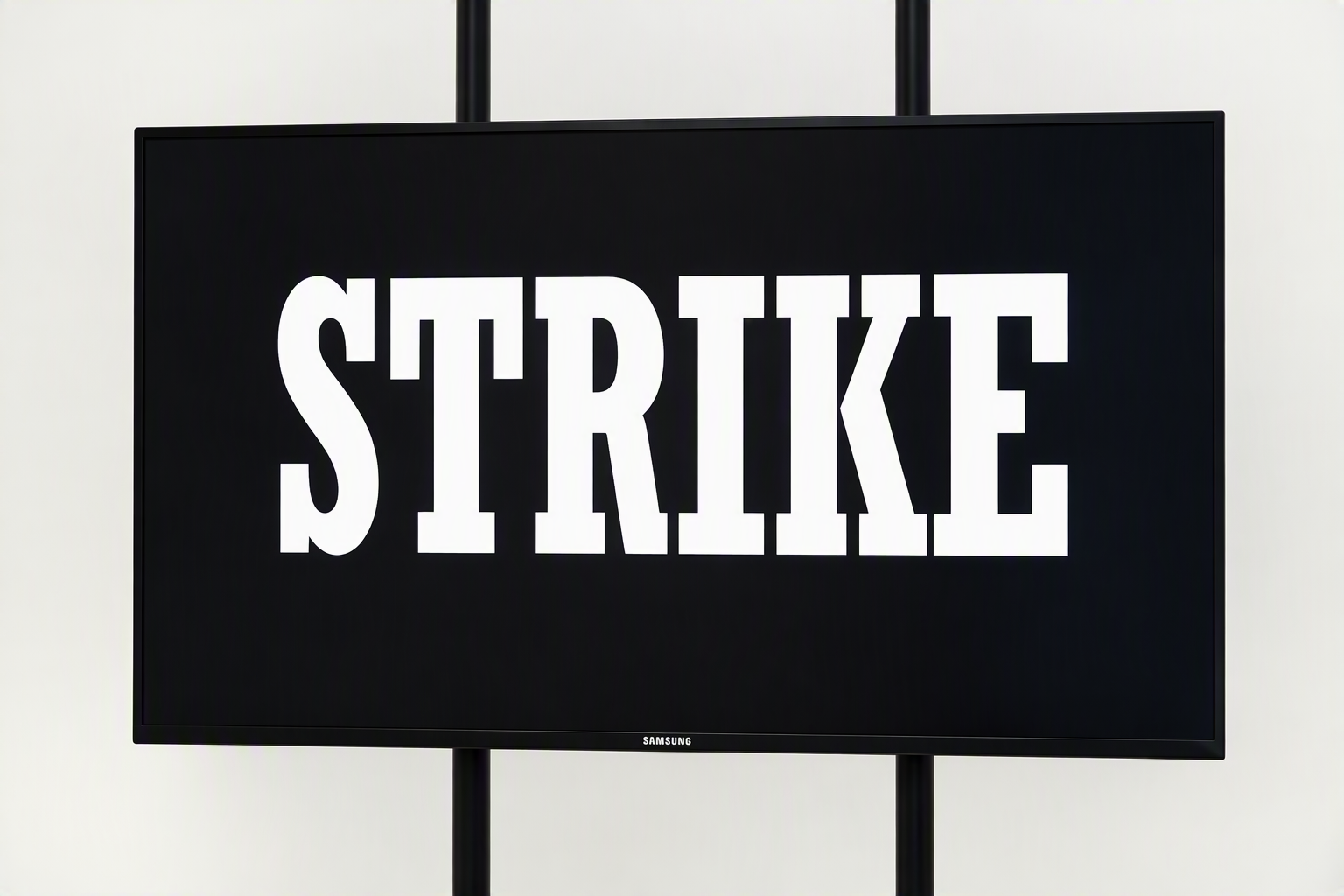
Hito Steyerl, Strike, 2010. Image courtesy of the Artist and Andrew Kreps Gallery, New York.
In her essay “The Terror of Total Dasein,” Hito Steyerl looks back on the International Artists’ Strike of 1979 as a “protest against the ongoing repression of the art system and the alienation of artists from the results of their work.” Steyerl’s short video Strike seems to lend filmic expression to her complex ideas about this subject.
The word “STRIKE” appears in large white letters that fill the entire black screen. “Strike” can have two different meanings: to hit something with force, or to refuse to work in order to get an employer to comply with one’s demands. With hammer and chisel in hand, Steyerl approaches a turned-off television and strikes it. Does this mean she is going on strike by destroying the television, a medium she relies on as a filmmaker? Or is her striking the television monitor as part of her artistic production?
The flat screen monitor is not really destroyed, however. Instead, an abstract image suddenly appears, revealing the matrix of pixels with which all images are generated on a monitor. Regardless of the content, the basic structure remains the same for all images. Strike could therefore also be understood as a reference to the uniform, predetermined way that media images are produced and perceived. Through the monitor’s “destruction,” the device loses its function; it is the victim of a strike. This highlights its nature as a technological object that has developed into the leading medium for the production and dissemination of media images since the 1950s.
Credits
Personal: Christoph Manz
Courtesy of the artist and Andrew Kreps Gallery, New York
Hito Steyerl
Hito Steyerl (1966, Munich) is a German filmmaker and writer who lives in Berlin.
Steyerl’s prolific filmmaking and writing occupies a highly discursive position between the fields of art, philosophy and politics, constituting a deep exploration of late capitalism’s social, cultural and financial imaginaries. Her films and lectures have increasingly addressed the presentational context of art, while her writing has circulated widely through publication in both academic and art journals, often online.
She has had solo exhibitions at Osservatorio Fondazione Prada (2025); Singapore Art Museum (2024); Portland Art Museum (2023); Kunsthaus Graz (2022); the National Museum of Modern and Contemporary Art, Seoul (2022); Stedelijk Museum, Amsterdam, (2022); Centre Pompidou, Paris (2021); K21 Kunstsammlung, Dusseldorf (2021); n.b.k, Berlin (2019); Park Avenue Armory, New York (2019); Kunstmuseum Basel, Basel (2018); Castello di Rivoli, Turin (2018); the Institute of Contemporary Art, Boston (2017); the Museum of Contemporary Art, Los Angeles (2016); Museo Nacional Centro de Arte Reina Sofia, Madrid, Spain; Artists Space, New York; Institute of Modern Art, Brisbane, Australia (2015); Van Abbemuseum, Eidenhoven, the Netherlands; ICA, London, UK; Künstlerhaus Stuttgart, Germany (2014); Museum of Contemporary Art (MCA) Chicago (2013); the Art Institute of Chicago; E-flux, New York (2012).
Group exhibitions include INDEX - Biennial of Art and Technology, Braga, Portugal (2026); ZOOM IN, Kunstmuseum Bonn, Bonn, Germany (2026); New Humans: Memories of the Future, New Museum, New York (2026); EVERYTHING IS INTERACTION, Kunstfestival Begehungen, Chemnitz, Germany (2025); MADE IN GERMANY? ART AND IDENTITY IN A GLOBAL NATION, Harvard Art Museums, Cambridge, MA (2024); Big Brother Blockchain, Nam June Paik Art Center, Yongin, South Corea (2024); Stranieri Ovunque - Foreigner Everywhere, 60th International Art Exhibition La Biennale di Venezia (2024); Universal / Remote, National Art Center, Tokyo, Japan (2023); The Sounds of the World, Castello di Rivoli Museo d’Arte Contemporanea, Rivoli, Italy (2023); Triennial, National Gallery of Victoria, Melbourne, Australia (2023); Universal / Remote, Contemporary Art Museum Kumamoto, Kumamoto, Japan (2023); Masquerades: Drawn to Metamorphosis, MOMENTA Biennale de l’image, Montreal (2023); Vasos comunicantes, Collection 1881 - 2021, Museo Nacional Centro de Arte Reina Sofía, Madrid, Spain (2022); May You Live In Interesting Times, held at the 58th Venice Biennale, Venice, Italy, and MCA Chicago (2018), Castello di Rivoli (2017), the Whitney Museum of American Art, New York (2016), and the German Pavilion of the 56th Venice Biennale in Venice, Italy, the Hannover Kunstverein in Hannover, Germany, and CAC Vilnius in Vilnius, Lithuania (2015); Cut to Swipe, Museum of Modern Art, New York; The Darknet, at the Kunst Halle Sankt Gallen, Switzerland, and the Bienal de la Imagen en Movimento, Goethe-Institut Buenos Aires, Argentina (2014); The Way of the Shovel: Art as Archeology, MCA Chicago; Nine Artists, held at the Walker Art Centre, Minneapolis, the Stedelijk Museum Amsterdam, the Netherlands, the Bergen Triennial, Norway, and the Venice Biennale (2013), as well as the Taipei Biennial and Gwangju Biennial (2010), documenta 12, Kassel (2007) and Manifesta 5, San Sebastián (2004).
A selection of her essays, spread throughout various publications, are summarised in four books: Die Farbe der Wahrheit (The Colour of Truth; Vienna: Turia Kant, 2008), The Wretched of the Screen (Berlin: Sternberg Press, 2012), Beyond Representation (Cologne: Walther König, 2016), and Duty Free Art – Art in the Age of Planetary Civil Wars (London: Verso, 2017; Zurich: Diaphanes, 2018)..