

What are you looking for?
You might be looking for...

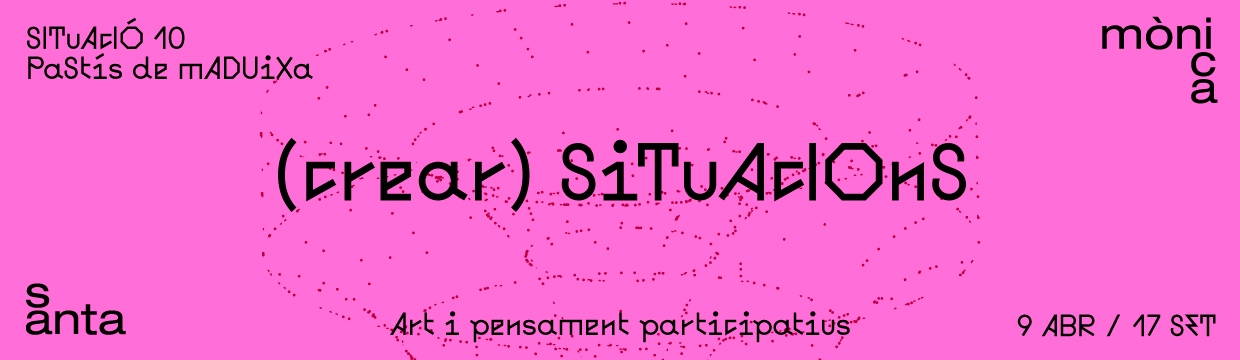
Situation 10. Strawberry cake
Situation (making): participatory art and thought. Collective learning and research programme
Pre-enrolment: until 5th February 2026

How do I know that I desire a strawberry cake in the first place? This is what fantasy tells me - Slavoj Žizek
This tenth edition of Situation (making): participatory art and thought opens up a space in which to collectively fabricate a critical device from which to analyse the illusory effect of various cultural devices of European modernity. The effect is to profoundly reconfigure our desire and our understanding of reality in our lives. The device that provokes it is the one that technically configures what appears to our senses in a certain way.
The course starts from the critical analysis that feminist theorists such as Laura Mulvey or Teresa de Lauretis developed from the 1970s onwards regarding one of these devices: cinema. These authors denounced how various techniques, by no means neutral, aligned for the same cause and according to the same ideological core, construct a regime of representation that normalises the heteropatriarchal system and moulds our perception of reality, our desire and our identities to match this system.
Based on these and other analyses, the course proposes that they can be extrapolated to other devices – from perspective to artificial intelligence, with a particular focus on the museum as a forger of illusion – which function as vehicles for many other ideologies which, together with heteropatriarchy, are at the basis of the project of European modernity: colonialism, extractivism, class construction and, of course, capitalism.
Is it possible to re-appropriate these dynamics of illusion-building? Is it possible to understand the guts of these devices in order to implement hacking strategies that redress the effects they provoke? Or, on the contrary, is the only way out to get rid of them and build an alternative system of cultural devices? These are some of the questions that will be asked during several sessions of this edition of Situation (making), in which the inner workings of the exhibition The Assault of Illusion (18.03.–27.09.2026) will be discussed from the point of view of the curatorial visit, texts will be analysed and conversations will be held with authors such as Andrea Colamedici, Frédéric Lordon, Andrea Soto Calderón, Adriana Murad Konings, Marta Echaves, Jacqueline Rose, Françoise Vergès, Jorge Volpi, among others.
With the participation of:
Andrea Colamedici (Roma, 1987) Italian philosopher, writer, and editor. Co-founder of the publishing house Tlon, dedicated to the dissemination of contemporary philosophical thought, and is one of the most prominent figures in public philosophy in Italy. He has written essays and works that combine philosophy, mythology, and reflection on identity, technology, and the meaning of life in the digital age. He also participates in conferences, podcasts, and cultural projects to bring philosophy closer to a wider audience.
Frédéric Lordon (França, 1962) French economist and philosopher, research director at the CNRS at the Centre Européen de Sociologie et de Science Politique in Paris. He is a professor at the École des Hautes Études en Sciences Sociales and a regular contributor to Le Monde diplomatique.
Andrea Soto Calderón, PhD in Philosophy, Professor of Aesthetics and Theory of Art at the Autonomous University of Barcelona. She has carried out her research in Valparaíso, Barcelona, Lisbon, and Paris. In addition to her teaching activity, she conducts an artistic research project on the workings of images at La Virreina Centre de la Imatge in Barcelona. Her research interests focus on the transformations of aesthetic experience in contemporary culture, artistic research, the study of images and media, as well as the relationship between aesthetics and politics.
Adriana Murad Konings (Madrid, 1997) PhD in Literature from the University of York. She graduated in General and Comparative Literature from the Complutense University of Madrid and completed a master’s degree in Literary Studies at Goldsmiths, as well as a master’s degree in Narrative at the Escuela de Escritores. She was one of the translators of the collected poetry of Hilda Doolittle. As a writer, she made her debut with Los días leves (Binomio, 2023), a novel that was a finalist for both the Herralde Novel Prize (2020) and the Nadal Prize (2023). Her second novel, Los idólatras y todos los que aman, was also shortlisted for the Herralde Novel Prize in 2023.
Marta Echaves (Madrid,1990) she studied Philosophy and specialised in the Independent Studies Program at MACBA. She is the activities coordinator at Caja Negra publishing house and works as a researcher, writer, and cultural programmer. She has written for artists’ catalogues and books, curated exhibitions, and taken part in juries and mentoring processes within creative residency programmes..
Jacqueline Rose (Londres, 1949) British professor and cultural critic, specialising in feminism, psychoanalysis, literature, and contemporary political issues. She is co-director of the Birkbeck Institute for the Humanities at the University of London and has published numerous books and essays addressing topics such as language, motherhood, literature, and the Israeli–Palestinian conflict. She is a regular contributor to the London Review of Books and a Fellow of the British Academy.
Françoise Vergès (París, 1952) French historian and political scientist specialising in postcolonial studies and decolonial feminism. Her research focuses on the history of slavery, decolonisation, and colonial memory. She has published numerous books and articles and has served as president of the Committee for the Memory and History of Slavery in France.
Jorge Volpi (Ciutat de Mèxic, 1968) is a Mexican writer, essayist, and academic. He studied Law and Letters and earned a PhD in Hispanic Philology at the University of Salamanca. He is one of the founders of the Crack Movement, which promoted a renewal of Mexican narrative, moving away from traditional realism. He gained international recognition with the novel In Search of Klingsor (1999), followed by works such as The End of Madness and It Will Not Be the Earth. His work combines literature, science, history, and political reflection, and has been awarded several literary prizes.
Programme coordinated by:
Enric Puig Punyet, PhD in Philosophy, writer, and curator. He is currently the director of the arts centre Santa Mònica, and previously directed La Escocesa, also in Barcelona. He has contributed to media outlets such as Le Monde Diplomatique, La Maleta de Portbou, and El Periódico de Catalunya, and is the author, among others, of the books La cultura del ranking (Bellaterra, 2015), La gran adicción (Arpa, 2016), El dorado. Una historia crítica de internet (Clave intelectual, 2017), and Los cuerpos rotos (Clave intelectual, 2020). He is also the co-author, with Yves Charles Zarka, of La Tierra no nos pertenece. Repensar el territorio y la nación (NED, 2017), and of the collective book Instantània d’una nova institució (Galàxia Gutenberg, 2024) on new institutional forms.
This course is aimed at anyone who, as a producer or theorist of culture, has the desire to delve into critical questions that in some way call into question the foundations of what we understand culture to be, and the effects that the instances of power that are inscribed in it have on society, and who wish to be part of a working group to collectively imagine possible deviations from this reality.
Although the course, because of the place from which it is thought and activated, will focus very particularly on the analysis of the "museum" device and, more generally, the "cultural institution", the sessions are also very actively proposed for people whose practice is focused on some of the other cultural devices of European modernity, such as theatre, literature, photography and cinematography. The collective thinking of the group will benefit from this multiple outlook, so the selection process will take particular account of the diversity of backgrounds among participants.
Maximum group of 12 people with a selection process.
General information
9 April to 17 September 2026 (13 sessions)
Thursdays, from 5:30 pm to 8:15 pm (49 teaching hours)
Dates of the sessions:
9 April
16 April
30 April
7 May
14 May
21 May
28 May
11 June
4 June
18 June
2 July
10 September
17 September (last session)
TIMETABLE
Catalan, Spanish, English, French and Italian.
If any of the participants does not understand the language of the session, simultaneous or consecutive translation will be provided as needed to ensure that everyone can follow the content.
LANGUAGES
€147 - General
€98 - Students, unemployed people, people with a legally recognised disability, those certified as a large or single-parent family, under 30s, over 65s and holders of a public library card.
PRICES
To apply for enrolment you must fill in the pre-enrolment form.
Maximum group of 12 people with a selection process. Once the pre-enrolment deadline has passed, all pre-enrolled applicants will receive an email telling them whether they have been accepted, rejected or are on the waiting list. Those admitted will have to pay the enrolment fee and provide proof of status to qualify for discounts.
Pre-enrolment period: from 13.01.2026 to 05.02.2026.
ENROLMENT
For any questions or further information you can write to santamonica@gencat.cat