

What are you looking for?
You might be looking for...

Il Nulla e la Rose - Group for Research and Training in Art and Mental Health
Entrar Afuera, Conferenza Permanente per la Salute nel Mondo Franco Basaglia (CoPerSAMM), Rete delle Cooperative Sociali CLU, La Collina y Agricola Monte San Pantaleone, ReSIST, Fernando Balius, Tau Luna, Radio Nikosia, Activament, Giovanna del Giudice, Laura Martín, Guillermo Giampietro

Il Nulla e le Rose - Group for Research and Training in Art and Mental Health explores the institutional logics and contradictions that permeate the lives of those experiencing mental suffering and their environments, how these determine lived experiences, and how to invent organised social responses (institutional, political, associative, expressive, etc.) that can influence these conditions and support people in a different way. We believe that art can provide a different logic and language to discuss the context and share lived experiences, but above all, it can help seek other solutions and build other pathways of care in the face of the evident fact that what exists today not only does not work, but also does harm. What expressive, artistic, experimental, non-normative languages can we find to break the closed circuit of mental health?
Three questions guide this proposal:
How is psychiatric power articulated today, as power and knowledge that determines the experiences of suffering (and the social organisation of the normal, the normative, the normal-like)?
How does this framework affect daily lives, and how can other care pathways be imagined in the territory beyond the coercive and asylum circuit?
What experiments and invented and artistic practices can emerge from these processes of translation into territories, their consequences, their durability, their sustainability, their possible hegemony?
To answer these questions, some of the key words that serve as a compass to guide the process are:
Psychiatric classification: the forms of control, structure and management of suffering as an illness, and the subalternity of the experience of suffering in relation to the normative values of social organisation.
Institutional violence: the structural elements and concrete devices that structure objective and subjective violence in contemporary psychiatric circuits.
Science and pharmacology: what role does industry play in the power and control relationships that exist today in mental health care settings, and what knowledge and beliefs are they based on?
Governance and welfare: what logics of care and social organisation govern public and private systems today? What tensions inhabit them and how do they relate to each other? What are the laws, regulations, white papers and grey legislation that affect everyday practices?
Exclusion and stigma: the social and subjective mechanisms of exclusion produced by the forms of social organisation and the determinants of suffering.
Territories and habitats: the possibilities that territories traverse as habitats of life, places of violence, and concrete spaces of the social contract.
Subjectivities and narratives: the subjectivities that permeate “mental health” services, the narratives that emerge from the experience.
Autonomy and diversity: interdependence, diversity, and dissent as elements that can determine other autonomies that affirm new forms of experience.
Expressive languages: the role that expressive, artistic, experimental, non-normative languages can play in breaking the closed circuit of mental health.
Deinstitutionalisation and structural change: the effects of structural transformation – deinstitutionalisation – that may arise from these processes of translation of practices to the territories, from experience, from autonomy, etc., and their consequences, their durability, their sustainability, their possible hegemony.
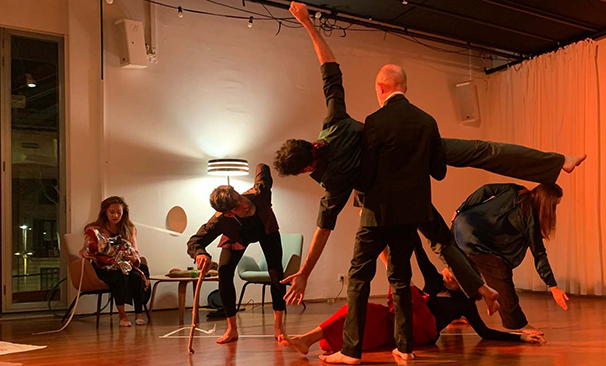
Entrar Afuera is a militant research collective that tries to think about and invent care practices in the city, reflecting and acting on the link between public institutions, territories and people. Its participants come from activism and spaces linked to care in various ways, including public health, culture and art, social movements, and radical education and pedagogy. Their journey began in 2016, with projects in Madrid, Trieste and Barcelona, working on the threshold between artistic practices, expressive languages and health, together with primary care and community health centres, mental health centres and museums and cultural institutions, such as the Museu Habitat (2024-2025).
Conferenza Permanente per la Salute nel Mondo Franco Basaglia (CoPerSAMM): Founded in 2010 by Franco Rotelli, Giovanna Del Giudice and Chiara Strutti, it pursues socially useful goals in the field of mental health, training and the protection of the human rights of vulnerable people, also through exchanges with other countries of the world. These objectives are pursued through: the promotion of innovative cultures and practices in the field of public social and health policies; practical criticism of total institutions and procedures of exclusion and limitation of rights; the promotion of training plans, studies, research, the evaluation of good practices, and national and international exchanges; the preparation of documentation and proposals on current legislation; participation in working groups in organisations and commissions at the local, regional, national and international levels; the promotion of exchanges with companies in the social economy sector, and support for the employment of vulnerable people. The theoretical and practical reference of CoPerSAMM is the deinstitutionalisation process initiated in the sixties by Franco Basaglia and continued by Franco Rotelli and his working group.
Rete per lo Sviluppo di Intrapresa Sociale nei Territori, ReSIST, is the network of companies that unites three historical realities of social cooperation in the territory of Trieste: the cooperatives Agricola Monte San Pantaleone, La Collina and Cooperativa Lavoratori Uniti Franco Basaglia (CLU Basaglia). The main objective of the ReSIST network is to develop a coordinated and integrated collaboration model that optimises resources and processes and strengthens the companies in the network in promoting the practices and values they defend, rooted in the process of deinstitutionalisation that has found one of its highest expressions in Trieste.
Fernando Balius is a philosopher, writer, and teacher specialising in mental health. His comic Desmesura won the audience award at Comic Barcelona and has been translated into English by the publisher Graphic Mundi and into Italian by Asterisco Edizioni. In it, he describes the experience of hearing voices in his head from a non-psychopathological perspective. He also publishes articles with a completely irregular frequency in the digital magazine CTXT. For two decades, he has been involved with groups and spaces dedicated to defending the rights of people with mental suffering.
Tau Luna, community mediator (Medellín, 1989), is a visual artist, researcher, manager, curator and teacher. A non-binary person and migrant, their practice revolves around human migration as an event linked to colonial violence, as well as listening and shared memory with more-than-human migrant beings. Their work combines ancestral, scientific, and intuitive technologies to investigate the soil, stones, listening, and memory of that which seems inert. In 2018, they co-designed and co-founded the Escuela de Artes y Oficios Electrónicos, an electrical trade and art school, in seven peripheral neighbourhoods of Bogotá. Between 2022 and 2024, they co-directed the La Creatura Re[d]productora Feminista cooperative in Barcelona, where they designed and coordinated the transfeminist educational area Urdimbre, which is still in operation. Their research (along with other local artists) on the systems of calls for proposals in France, Catalonia and the Balearic Islands led to the publication of the Guia per a unes Convocatòries Cuidades [Guide to well-designed calls for proposals] by the PAAC, currently in use in Barcelona, and they are working with their collective Lumbre to bring about the Guia de recursos per a persones migrants a Barcelona [Resource guide for migrants in Barcelona]. They have given seminars and participated in study groups at Escola Massana, BAU and EINA in Barcelona, as well as at the University of California at Berkeley, Dartmouth College, the University of Bristol, the Universidad de Antioquia in Colombia and FLACSO in Ecuador, among others. They have co-curated exhibitions at the MACBA and Centre LGTBI de Barcelona. They have designed mediation processes for institutions such as the Fundació Miró, the CCCB and La Escocesa in Barcelona.
Radio Nikosia is a device, a collective and an association made up of people with and without medicalised histories of suffering: artists, economists, philologists, writers, poets, dieticians, doubt professionals, psychologists, educators, anthropologists, and many others. From here, it asserts itself as a social space in which the struggle avoids forced identity exclusions in order to open up to the necessary plurality in any encounter that intends to address complexity.
Activament is a first-person mental health association, constituted, organised and directed by people who have lived or are living through situations of psychosocial suffering and/or mental diversity. The organisation also includes "partner friends", people who have not gone through this experience, but who share the commitment to building a more just, inclusive society that respects diversity. For more than 10 years, Activament has been working to offer spaces for mutual support, defending the rights of people with psychosocial suffering and promoting participation and collective organisation. Through activities, meetings, and advocacy actions, it seeks to give voice to the community, combat the stigma associated with mental health, and contribute to generating a more dignified, community-based, and rights-based perspective.
Giovanna Del Giudice is a psychiatrist who has collaborated with Franco Basaglia and Franco Rotelli. She played a prominent role in the 1970s in Trieste in the process of closing the asylum and building the territorial mental health services network. She has directed the Mental Health departments of Caserta 2 (2002-2006) and Cagliari (2006-2009). Committed to fight all types of totalitarian institutions, she has actively participated in the process of overcoming the judicial psychiatric hospital (OPG, in the Italian acronym). She is the national spokesperson for the state campaign “…E tu slegalo subito” to abolish mechanical restraint in care services. Since 2013, she has been president of the Conferenza per la Salute Mentale nel Mondo Franco Basaglia and coordinates international cooperation projects in the field of mental health.
Claudia Delso Carreira (A Coruña, 1986) is a researcher, art historian and cultural worker. In 2011, she co-organised the 1st Festiclown Palestina, a social circus festival that took place in the occupied Palestinian territories in partnership with numerous Palestinian entities. Between 2015 and 2022, she was Councillor for Participation and Democratic Innovation in A Coruña City Council with the municipalist platform Marea Atlántica, from where she promoted numerous radically innovative public policies. Between 2022 and 2024, she co-organised the seminar “Rethinking the museum: institutional practice and mezzopolitics” within Tejidos Conjuntivos, the Museo Nacional Centro de Arte Reina Sofía's programme of studies in Critical Museology, Artistic Research Practices and Cultural Studies, in Madrid. She is interested in institutional practices and political imagination, networking and interdisciplinary work, and participatory and experimental methodologies. She is a friend and collaborator of LAAV, Entrar Afuera and Common Ecologies, among others.
Laura Martín is a Spanish psychiatrist, director of the School of Mental Health of the Spanish Association of Neuropsychiatry, and co-founder and president of the critical psychiatry collective La Revolución Delirante, an association aligned with the anti-institutional principles of the Democratic Psychiatry movement founded by Franco Basaglia and Franca Ongaro in Italy. She practices medicine with the Hospital Universitario Virgen de la Victoria Intensive Community Treatment Team (ETIC) in Málaga. She was the coordinator of the Community Intervention Centre of the Hospital Universitario Río Hortega in Valladolid from its opening in 2013 until its closure in 2019, and a psychiatrist at the Hospital Universitario Virgen de las Nieves day hospital in Granada. Her published articles include “Subjetivismo crítico. Una respuesta a los manuales diagnósticos” (2014) and “Manual de instrucciones para la deconstrucción de un dispositivo” (2017), and she is the author of the book Manual de psicopatología (La Revolución Delirante, 2018).
Guillermo Giampietro is an Italian-Argentine artist born in Rosario in 1962. In 1979, he founded the experimental group Cucaño, with which he developed an intense artistic research and political-cultural resistance during the Argentine military dictatorship. In 1989, he moved to Trieste, where he participated in the deinstitutionalisation of the old psychiatric hospital, led by Franco Basaglia; critically explored the relationship between art and emancipation, also from the perspective of madness; and directed the P Laboratory of visual arts from the mid-nineties. For over twenty years, he has been holding exhibitions and performances in several countries, working across poetry, painting, video, installation, film and radio. Since 2000 he has co-directed the programme Escuchame on Radio Fragola with Lara Baracetti.