

What are you looking for?
You might be looking for...

Toxicidad y Colonialismo
Salma Amazian, Rodrigue Mouchez Armendariz, Helios F. Garcés. In collaboration with the AGUAS platform
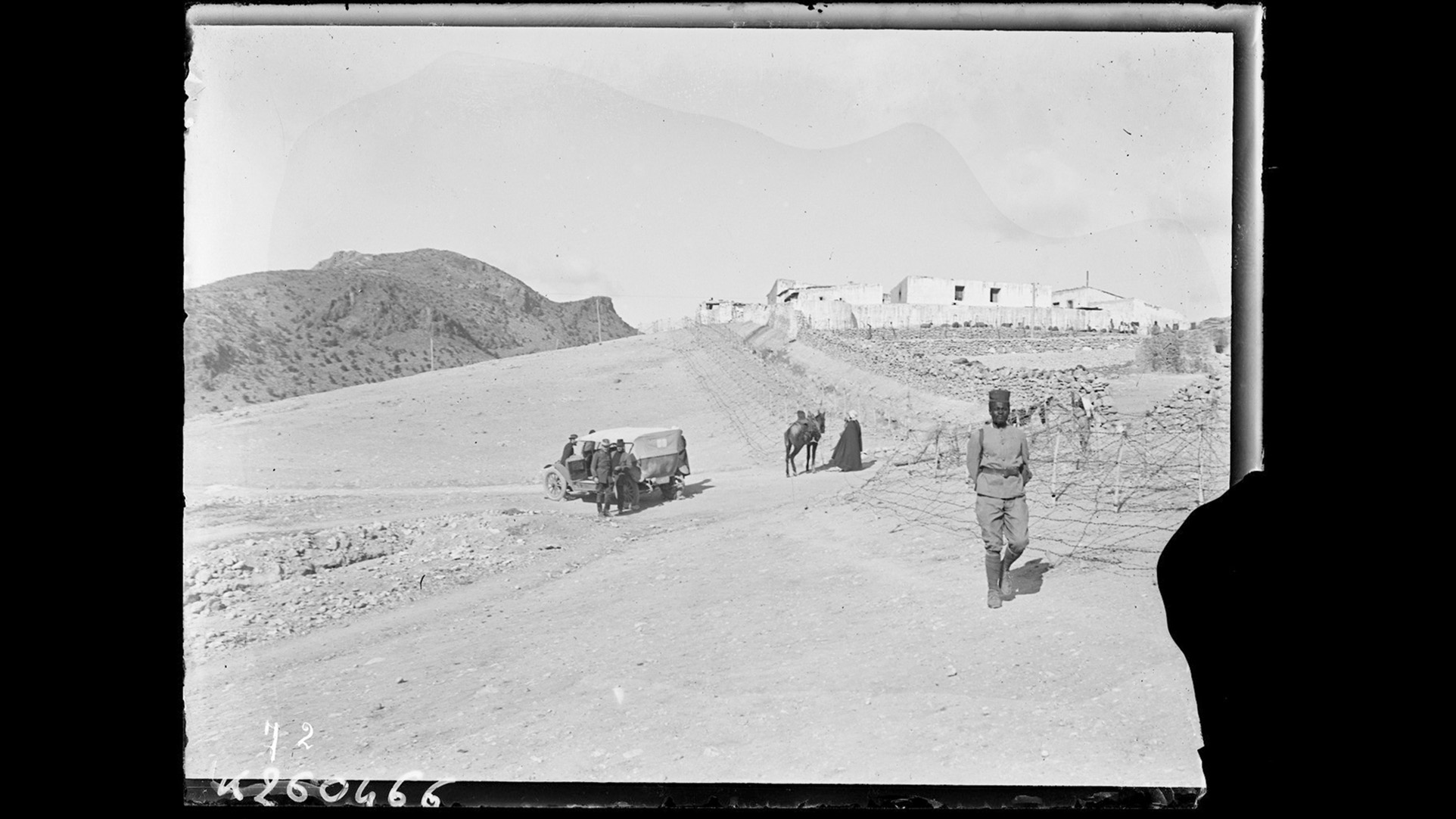
French military post in Hassi-Ouenzga (Eastern Rif, Morocco), 1922. In the foreground, a Senegalese rifleman, an African soldier recruited by the French colonial army and deployed in the Rif. The BnF (National Library of France) catalogue describes this photograph as a “military camp” and “mountain landscape.” The African body in the foreground does not exist as a subject within the institutional record. Photograph by Jean du Taillis, published in “L’Illustration” and distributed by the “Rol” agency during the French occupation of the Rif, one year after the proclamation of the Rif Republic by Abdelkrim El Khattabi (1921). Source: gallica.bnf.fr / BnF.
The Toxicidad y Colonialismo (Toxicity and Colonialism) research group takes as its starting point a transdisciplinary and comparative exploration of the French and Spanish imperial and colonial legacy, particularly its toxic aspect and the continuity of its toxic, extractivist, racist and deeply violent logics. The group functions as a research framework in which we will share lines of work, while each researcher formulates their own artistic, curatorial and/or publishing proposals. Based on two historical episodes, among others, the use of chemical weapons by Spain in the Rif War (1921-1926) and the nuclear tests by France in Algeria between 1960 and 1966, the research group is committed to a narrative that shifts the focus from the centres towards what is invisible, what resists on the margins of History. The research will seek to connect different points of invisible colonial toxicity through the traces it leaves on territories, bodies, beings, subjectivities and imaginaries.
Biographies:
Salma Amazian is a researcher, teacher and writer who, from a decolonial perspective, addresses the intersection of race, class, and gender in the experiences of oppression and resistance of racialised communities in Spain, and especially in the colonial dynamics between Spain and Morocco and the coloniality that runs through them to this day. She holds a degree in History and Social Anthropology from the Universitat Autònoma de Barcelona (UAB) and a doctorate from the University of Granada (UGR) with a thesis on the processes of securitisation as colonial violence and community resistance in the Spanish context. Most notable among her recent works are her co-authorship of the book La radicalización del racismo (2019) and her direction of the documentary Es por tu seguridad. Engranajes de la islamofobia institucional (2021) and her curatorship of the University of Seville and the Institute of Culture and Arts of Seville (ICAS) training programme “La raza como disputa cultural” and its related activities (2021). She has been invited to venues such as the ICAS, MACBA, the Santa Mònica, Museu Habitat, the European Network Against Racism (ENAR), CAGE, International Islamophobia Studies Research Association (IISRA) and the Universitat Autònoma de Barcelona (UAB), the University of Barcelona (UB), the BAU, College of Arts and Design of Barcelona, the University of Girona (UdG) and the University of Granada (UGR).
Franco-Mexican artist, curator and researcher, Rodrigue Mouchez Armendariz develops a curatorial practice that unfolds in exhibitions, public programmes and long-term research initiatives. Through AGUAS, an independent curatorial platform he founded in 2017, he has conceived projects in collaboration with artists, curators, academics and writers in Latin America, Europe, North America and North Africa. His work examines, from a critical and transdisciplinary perspective, how contemporary cultural production reflects and strains power structures, paying attention to memory, transmission, and translation as spaces where we negotiate which voices are amplified and which are silenced, and how the frameworks for interpreting the world are constructed. He has collaborated with public institutions, galleries and independent spaces, and his recent projects include “Performing Colonial Toxicity”, by Samia Henni, at DOC, Paris (2025); “Un intersticio en todas partes a la vez”, a double exhibition by Iagor Peres and Mercedes Pimiento at AGUAS, Barcelona (2024), and Fuel for Fire, by Carolina Caycedo, at AGUAS, Barcelona (2023). He studied at the École Nationale Supérieure des Beaux-Arts de Lyon (Ensba Lyon) and at the Centre Chorégraphique National de Montpellier, France.
Helios F. Garcés is a writer. He began his studies in Philosophy and graduated in Communication. He investigates the politics and narratives of race, racism, and historical memory in the context of the Spanish State and the role that cultural and literary production, historiographical approaches, communicative narrative, artistic/museum practices, and urban space play in the exaltation of imperial, colonial, and fascist memory, as well as the Islamic intellectual tradition, its emancipatory dialogues, and Muslim mysticism. He has written for Diagonal, El Salto, CTXT, La Marea and Público. He is the author of Literatura y raza (2025), Religión vs. Revolución. Malcolm X, musulmán de la liberación (2023), Entrevista a un insecto atravesado por la luz (2021) and Mi abuela no ha leído a Marx (2019) and has contributed to books such as Podría quemarte (2025), Mares entrelazados, conexiones mediterráneas (2023), Racismo de Estado. Una mirada colectiva desde la autonomía y la justicia racial (2023) and Miradas en torno al problema colonial. Pensamiento anticolonial y feminismos descoloniales en los sures globales (2019).