

What are you looking for?
You might be looking for...

Santa Mònica 40 Anys
Natalia Carminati and Conxita Oliver
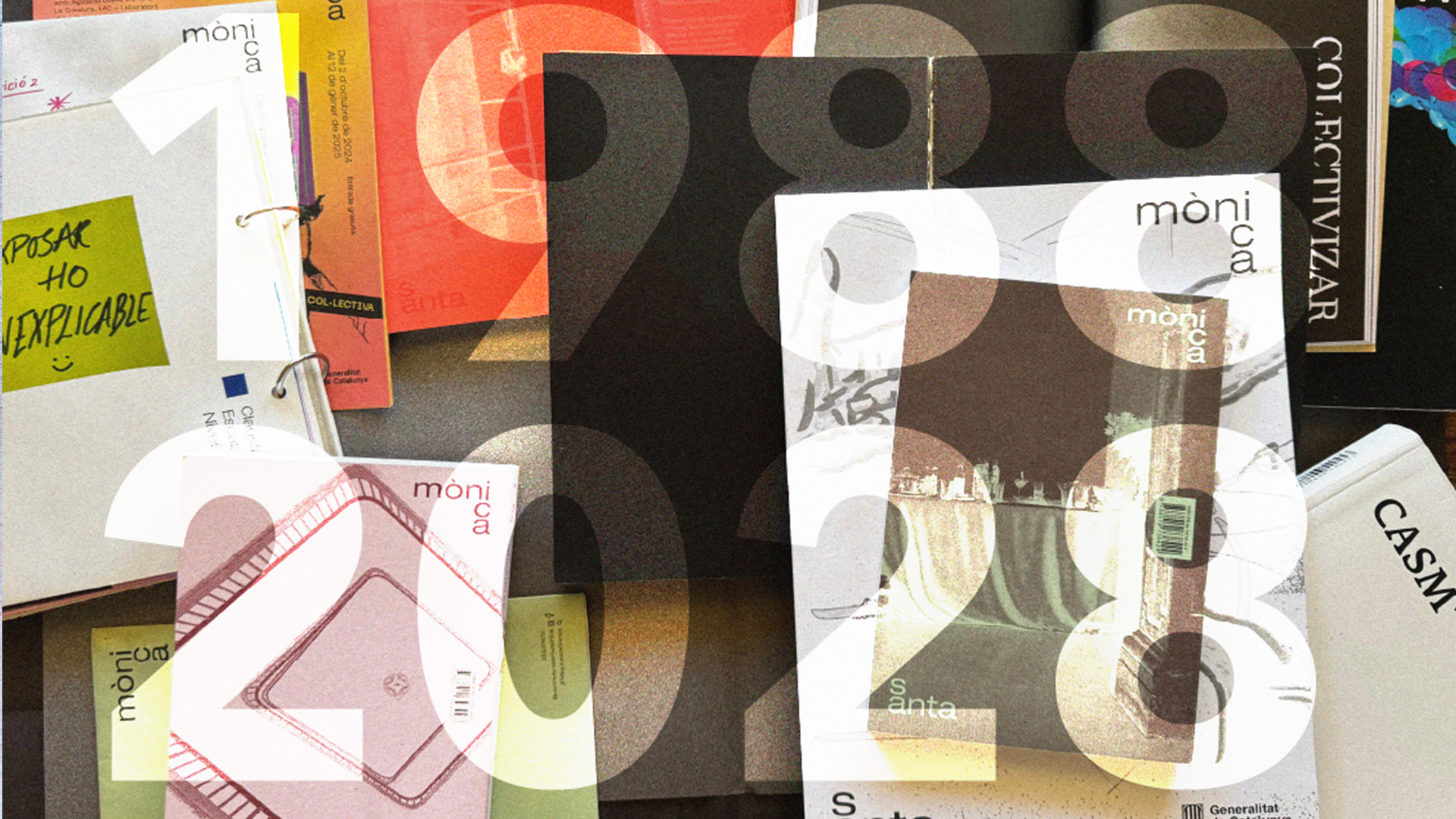
The Santa Mònica 40 Anys (Santa Mònica 40 Years) research group, formed by Natalia Carminati and Conxita Oliver, will investigate the conceptual relationship and formal experimentation of the stages of the Santa Mònica (1988-2026) to draw dialogues between the exhibitions, activities and projects throughout the different periods.
The intention is to dilute the fragmented view that exists of this facility in order to find the common thread that unites the different lines of work and to show the symbolic and material value that has nourished the Catalan artistic ecosystem. The idea is to create a core exhibition space featuring a selection of works by national and international artists who have participated in the Santa Mònica over the years with experimental proposals. For the website, a series of branches will be formalised based on certain concepts and their possible intersections, the morphology of the works exhibited, the creative identities and others that will become relevant as the research progresses.
The methodology is based on mediation between the agents who have intervened throughout its history (directors, artists, curators…) to generate debate and conceptual content, as well as on the review of catalogues and publications that collect reflections on the organised exhibitions. The work plan will start from the emptying of the documentation from all the exhibitions, projects, activities and publications (1988-2026) that the documentalist is developing together with the research team.
The research aims to create an intergenerational narrative with a common denominator of crossings and confluences of contemporary creation in a space that has been a nucleus of dialogue and encounter; of fertile contaminations and frictions that embody permeable processes of institutional transformation both in the fabric of the nearest neighbourhood and in international vanguard processes. We will not talk about themes, but about obsessions and situated experiences that run through all the Santa Mònica's stages: feminisms, ecology and sustainability, social and political problems, borders and territories, and gastronomy and art.
Biographies:
Natalia Carminati (Buenos Aires, 1982) is a visual artist and researcher. Her research work and the conceptual development of her practice are oriented towards the critical study of contemporary culture, postcolonial theory, biotechnology and food sovereignty. Her projects materialise in the creation of multisensory devices that integrate video games, installation, painting, audiovisual languages, living organisms, food and performance.
She has participated in individual and collective exhibitions and performances at MACBA, the Picasso Museum, the Santa Mònica, El Born CCM and Fabra i Coats (all in Barcelona), the Las Cigarreras Cultural Centre (Alicante), L'Estruch (Sabadell), Konvent Zero (Berga), the Casa de Cultura de Sant Cugat del Vallès, Hybrid Art Fair (Madrid), SWAB Barcelona Art Fair, LOOP Barcelona, the Grec Festival, the Sâlmon Festival, Linden New Art (Melbourne), cheLA (Buenos Aires), the Ostavinska Galerija (Belgrade), the Michigan State Museum (USA) and the Kunstmuseum Stuttgart (Germany), among others. She has received awards and grants from the Generalitat de Catalunya, Barcelona City Council and Baden-Württemberg, among others. She has worked as an artist in residence at Fabra i Coats, Konvent Zero, Piramidón Centre d'Art Contemporani, Belgrade Artist in Residence (BAIR), La Escocesa and the Santa Mònica. Since 2022, she has been part of the board of the Assembly Platform of Artists of Catalonia (PAAC).
Conxita Oliver (Barcelona, 1957) is a historian, art critic and exhibition curator. She has published articles in newspapers and magazines, has curated around fifty exhibitions, and is the author of books and monographs on contemporary art topics. She sits on art awards panels, advises on programming and collections, and has catalogued various public and private collections. She has always understood her dedication from a transversal and pluralistic perspective. Her professional career's two main focuses have been art criticism in different media – written and radio – and cultural management carried out from the Generalitat de Catalunya Ministry of Culture. This intersection between the public and the private is what has allowed her to influence broad aspects of art. She has been curator of the Generalitat de Catalunya Art Fund (1987-2002), head of the Ministry of Culture's Public Network of Visual Art Centres and Spaces of Catalonia (2012-2016), director of the Santa Mònica (2012-2014) and coordinator of the Comprehensive Plan for Visual Arts of Catalonia (2014-2021). Currently, she is a member of the Generalitat de Catalunya Ministry of Culture Acquisitions Committee in the field of post-war and second wave of avant-garde and a member of the Board of Qualification, Valuation and Export of Historical and Artistic Heritage Assets of Catalonia as an expert in contemporary art, a position she had already held between 1993 and 1996. She received the GAC 2022 Award for art criticism, granted by the art galleries of Catalonia, in recognition of her professional career as well as the research award given in 2024 by the Catalan Association of Art Critics for the exhibition “Un altre art. Informalisme a Catalunya. 1956-1966”, for the recovery of one of the most important movements of the second half of the 20th century.